5 October 2026
Why Shadow AI Is a Governance Problem for Malaysian Enterprises

Your Mobile Device Management (MDM) policy covers the device. It says nothing about what an app on that device is quietly sending to an AI model hosted somewhere else.
That gap has a name now, Shadow AI, and Zimperium’s 2026 Global Mobile Threat Report puts real numbers behind how large it already is. In this article, we break down what Shadow AI actually looks like on mobile, why it deserves a closer look against Malaysia’s Cyber Security Act 2024, and why closing this particular gap starts with policy rather than software.
Executive Summary
- 45% of employees are now regular users of AI on their corporate devices, authorised or not, up from 15% the year before.
- Of those users, 67% are doing it through non corporate accounts, meaning the organisation has no visibility into the session, the account, or where the data goes.
- The most common data type submitted to unauthorised AI tools is source code, followed by images and other structured data. In 3.2% of violations, employees uploaded research and technical documentation, a direct intellectual property exposure.
- Mobile makes this worse than the laptop version of the problem, no browser extension or corporate login is needed to reach the same clipboard, storage and camera that an approved work app uses.
- Malaysia’s Cyber Security Act 2024 places new emphasis on risk visibility and reporting for organisations designated as operating National Critical Information Infrastructure (NCII), and the accountability principles it reflects are relevant well beyond that group.
- No mobile security tool, including purpose built mobile threat defense platforms, currently monitors what an employee types or pastes into an AI app. Closing this gap starts with policy, not a product.
What Shadow AI Actually Is, in Plain Terms
Shadow AI is what happens when employees use AI tools on company devices without those tools being approved, reviewed, or even known to the security team. It’s rarely intentional harm. Someone wants to move faster, so they paste a chunk of code into a chatbot to debug it, or drop a document into an AI tool to summarise it. The productivity gain is real. So is the fact that nobody in the organisation knows where that data went afterwards.
Zimperium’s data shows this is now mainstream behaviour, not an edge case. 45% of employees are regular AI users on corporate devices, and two thirds of that usage happens through personal, non corporate accounts. That means even organisations with an official, sanctioned AI tool still have a much larger amount of unsanctioned use happening in parallel, invisibly.
Why Mobile Makes This Harder to Catch
On a laptop, Shadow AI usually shows up as a browser tab or an extension, something a reasonably mature DLP setup has a chance of flagging. On mobile, there’s no equivalent tell. A GenAI app installed on a phone reaches the same clipboard, storage and camera that any approved work app uses, without needing a corporate login or leaving the same kind of trail.
The type of data at risk is exactly what you’d expect from a workplace: source code is the single most common thing submitted to unauthorised AI tools, followed by images and other structured data. Research and technical documentation showed up in 3.2% of violations Zimperium tracked, which is a direct intellectual property exposure, not just a policy breach.
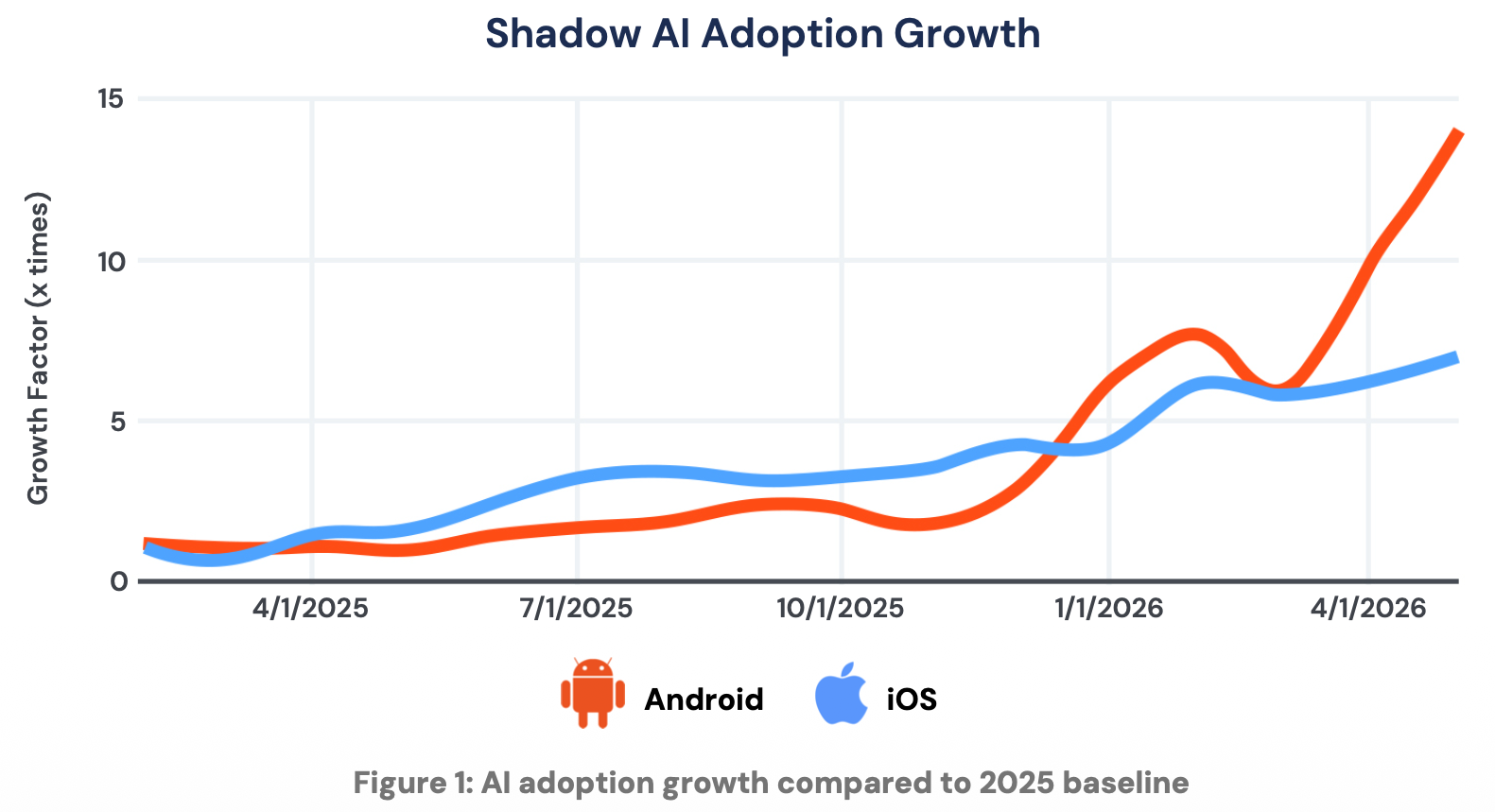
There’s a second version of this problem too. Many business apps that were approved months or years ago have since had AI features added to them, quietly, in an update nobody reviewed. Zimperium’s zLabs data shows AI adoption in business apps growing 136%, and AI embedded apps overall up 14x on Android and 7x on iOS. An app your security team signed off on last year may not be the same app it is today.
Why This Isn’t a Problem a Security Tool Solves on Its Own
Mobile Device Management covers the device, not what an app on it sends to a model hosted elsewhere. Data Loss Prevention controls, even well configured ones, only work within apps the enterprise manages, and as one line in the report puts it, “the data doesn’t need to be copied to leave. It just needs to be seen.” An employee can photograph a screen, upload a file from local storage, or type sensitive information directly into a chat window, none of which any current mobile security tool, including purpose built mobile threat defense platforms, is built to see or stop.
That doesn’t mean technology has no role. Where a mobile threat defense platform genuinely helps is at the app level, spotting that a GenAI app has been installed at all, or flagging when a business app your team approved has quietly shipped an update that adds an embedded AI feature. That’s real, useful visibility. It’s just a different thing from monitoring the content an employee sends to that app once it’s open, and that distinction matters if you’re deciding where to put your time and budget. This is a visibility and governance gap, not a tooling gap, every app carrying an AI model needs to be vetted under one consistent policy, rather than expecting a single product to close the hole.
Where the Cyber Security Act 2024 Comes In
The Cyber Security Act 2024, officially gazetted by the Attorney General’s Chambers and enforced by the National Cyber Security Agency (NACSA), was built around a fairly simple idea, organisations that hold or manage critical or sensitive systems need to actually know what their risk exposure looks like, and be able to demonstrate that to regulators when asked. Shadow AI sits directly against that principle.
For organisations designated as operating National Critical Information Infrastructure, the Act introduces obligations around risk assessment, audits, and incident reporting. Shadow AI complicates all three. You cannot meaningfully assess a risk you cannot see. You cannot audit a data flow that never touched an approved system. And if sensitive data left the organisation through an unsanctioned AI tool, it may not even register as an “incident” under existing detection processes, because nothing was technically breached, the data simply walked out through a channel nobody was watching.
This isn’t legal advice, and every organisation’s specific obligations under the Act depend on its designation and sector. What we’d encourage is a conversation with your compliance function about whether your current risk assessment process accounts for AI usage on mobile devices at all. For many organisations, right now, the honest answer is no.
A Parallel Consideration Under PDPA
Separately from the Cyber Security Act, Malaysia’s Personal Data Protection Act remains relevant here too. If an employee pastes customer information, contact details, or other personal data into an AI tool the organisation never approved, that data has left the organisation’s control in a way the PDPA’s principles around data processing were never designed to accommodate. It’s a second reason this gap deserves board level attention, not just an IT policy update.
Four Questions for Your Next Security Review
- Does our AI usage policy extend to personal and BYOD devices, or only company issued ones?
- Do we have a process for re-reviewing approved apps when they add new AI capabilities?
- If asked to demonstrate our risk visibility into AI usage today, could we actually produce an answer?
- Who in our organisation actually owns this policy, and does it reach past IT into compliance, legal and HR?
Closing the Gap Starts With Policy, Not a Product
Given everything we’ve just mentioned, the starting point isn’t software. It’s a policy that reaches every device employees use for work, including personal ones, paired with a clear answer to who owns it. That’s a governance exercise. Defining what’s allowed, extending existing AI and data policies to mobile and BYOD, and building the process to re-review apps when they change.
Vigilant Asia is a certified partner delivering Zimperium’s Mobile Threat Defense platform, which can help with the app level visibility described above. The policy itself is a decision for your own compliance and legal teams, and our role is giving them the visibility to make it with.
What Shadow AI Means for Mobile Compliance in Malaysia
Shadow AI didn’t arrive with a warning. It arrived quietly, through ordinary employees trying to get their work done faster, on devices that were never built for this level of scrutiny. Against a regulatory backdrop like the Cyber Security Act 2024, the question isn’t whether this gap exists, Zimperium’s data confirms it does, it’s whether your organisation has a policy that actually covers it, since no tool on the market closes this one alone.
If you’d like to understand what visibility into AI usage on your organisation’s mobile devices currently looks like, contact us for a conversation.